Nigerian Cocoa Bean Grades Explained: What Grade I and Grade II Really Mean
Every cocoa contract names a grade, but few buyers outside the trade know exactly what the cut test measures. Here is how Nigerian cocoa is graded and what it means for your price and your process.
When a Nigerian exporter offers you "Grade I main-crop beans", four words are doing a great deal of work. They define the defect limits the cargo must meet, the season it came from and — indirectly — the price. This article unpacks the grading system used for Nigerian cocoa so that you can read offers, specifications and inspection reports with confidence.
Who grades cocoa in Nigeria?
Export cocoa in Nigeria is graded by the Federal Produce Inspection Service (FPIS), a department of the Federal Ministry of Industry, Trade and Investment. Inspectors sample bagged lots at the exporter's warehouse, perform the cut test and issue a grading certificate that accompanies the shipment. The grading limits applied are aligned with the international standard ISO 2451 (Cocoa beans — Specification and quality requirements).
The cut test
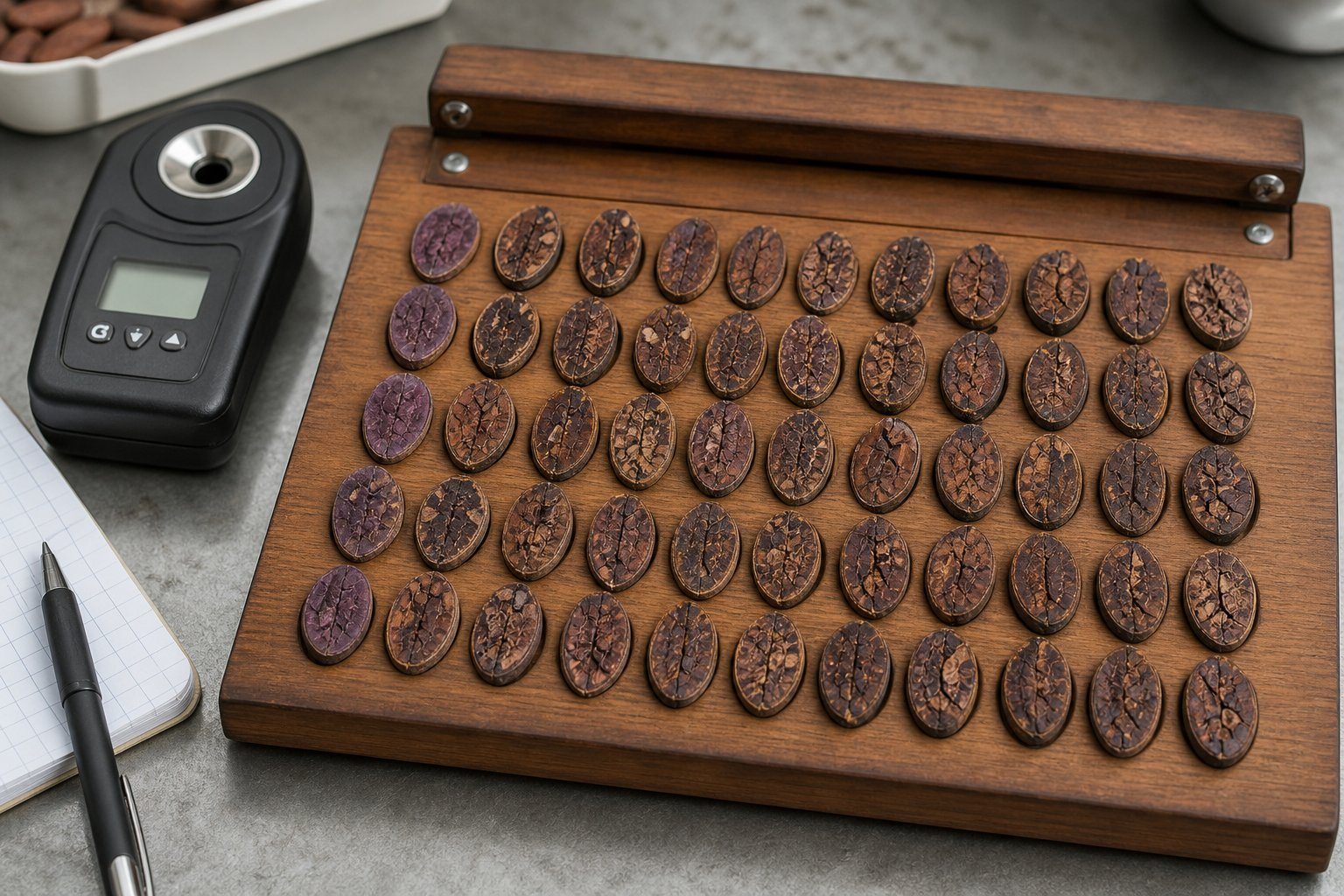
A representative sample — conventionally 300 beans — is cut lengthwise through the middle and each half is examined. Beans are classified by their internal appearance:
- Well-fermented — fully brown, with an open, cracked structure. This is what you want.
- Partly purple — brown with purple patches; acceptable in limited proportion.
- Slaty — grey, compact, cheesy texture: the bean was not fermented. Slaty beans are bitter and astringent.
- Mouldy — visible mould inside the bean. Mould produces off-flavours and can carry mycotoxins; it is the most serious defect.
- Insect-damaged, germinated or flat — physical defects that reduce usable cotyledon.
Grade limits
| Defect (max %) | Grade I | Grade II |
|---|---|---|
| Mouldy beans | 3 | 4 |
| Slaty beans | 3 | 8 |
| Insect-damaged, germinated or flat beans | 3 | 6 |
Beans that fail Grade II limits are classed as sub-standard and are not eligible for export under the normal grading certificate. In addition to the cut test, exportable cocoa must be properly dried (moisture is usually limited to around 7.5% in contracts), reasonably uniform in size, free from foreign matter, live insects and abnormal odours, and packed in clean, sound bags.
Bean count and bean size
Grade alone does not describe bean size. Contracts therefore also specify a bean count — the number of beans in 100 g. Lower counts mean bigger beans and a higher shell-to-nib ratio in your favour. Nigerian main-crop beans are typically contracted at around 100 beans per 100 g or fewer; light-crop beans run higher. Count affects price and should always appear on the specification.
Why this matters commercially
- Price. Grade I earns a premium over Grade II; both are quoted as a differential to the futures market.
- Yield. Fewer defective beans means more usable nib and better butter yield per tonne.
- Flavour. Slaty and mouldy beans degrade flavour; chocolate makers are far more sensitive to this than powder producers.
- Claims. A clear grade and bean count on the contract, confirmed by FPIS and optionally by your inspector, gives you a basis for any quality claim at destination.
Renamy Cocoa Nigeria cut-tests every lot on intake and again before bagging, and ships only against the grade written on your contract. See our cocoa grades or request a quotation.
Sourcing cocoa beans from Nigeria?
Get a written quotation and specification within two business days.
More Insights
Ready to Source Export-Grade Cocoa Beans from Nigeria?
Tell us your grade, tonnage, packing and destination port. Our export team will prepare a detailed FOB or CIF quotation and a sample plan.